




The most important things in brief:
What are the benefits of bodybuilding for women? Women benefit like men from numerous health benefits of strength training. Bodybuilding can lead to more muscle mass, less fat and prevent numerous cardiovascular diseases.
How should women train in bodybuilding? Women in bodybuilding should train similarly to men, but often benefit from higher repetition numbers, greater training volume and a higher training frequency.
What should women pay attention to regarding nutrition in bodybuilding? Women should above all pay attention to sufficient healthy fats in their diet. In addition, proteins are important for women for muscle building (1.8–2.0 g/kg body weight. Carbohydrates and fats should be adjusted depending on activity. As mentioned, healthy fats and omega-3 fatty acids are essential for the female hormonal balance.
What health aspects do women in bodybuilding need to consider? To avoid risks such as the "Female Athlete Triad" (energy deficiency, menstrual disorders, bone loss), women should avoid extreme diets and very low body fat percentages in the long term.
Why strength training is important for women
Nowadays, more and more women are also reaching for the dumbbells and signing up at a gym. This is a positive development, as strength training offers numerous benefits for women.
The health benefits of strength training for women are scientifically very well documented.
Muscle mass and fat loss
Strength training offers numerous health benefits, especially in old age, that go far beyond pure muscle building. Already 12-20 working sets per week can lead to a significant increase in muscle mass, which increases the basal metabolic rate, as muscle tissue consumes more calories than fat. This is particularly important for fat loss, because strength training not only reduces body fat, but also improves metabolic health. Especially intra-abdominal fat, which is problematic in older people and women in menopause, is significantly reduced by strength training. In addition, it improves insulin sensitivity and increases calorie consumption at rest.
The increased calorie consumption due to more muscle mass is a very important point. "Cardio", such as running or jogging, is used far too often with the goal of losing fat. However, this unfortunately does not bring the desired success. It is much better to do strength training and build muscle. This way, you permanently increase your calorie consumption through more muscle mass. In addition, muscle mass is maintained or further developed in a diet. With classic "cardio", no muscle mass is built up and too much cardio can potentially lead to muscle mass loss.
Cardiovascular health and mental benefits
In addition to body composition, strength training also increases everyday functionality, as greater strength makes it easier to cope with everyday tasks. It has a preventive effect against diabetes and is recommended as an effective measure to reduce the risk as well as to treat diabetes. At the same time, the cardiovascular system and bone health also benefit: Regular training increases bone mineral density and can counteract osteoporosis, especially in critical areas such as the femoral neck and the lumbar spine. For cardiovascular health, strength training shows similar benefits to classic endurance training.[1]
The mental health also benefits greatly from strength training. It can relieve symptoms of anxiety, fatigue and depression and increase self-esteem, especially in older people, women and cancer patients. In addition, it has a positive effect on cognitive abilities in old age and helps with pain relief in chronic diseases such as osteoarthritis or fibromyalgia. Overall, strength training offers a wide range of health benefits that cover both physical and psychological aspects.[2]
For all these reasons, strength training makes sense for women just as it does for men.
 Female bodybuilders do not need to fear too much muscle mass, as women cannot build muscle mass like men due to their physiology.
The optimal training for women in bodybuilding
Basically, it can be said that women can and should train just like men. The same training principles (training intensity, training volume, training frequency) also apply to women. You can find training principles for men and women in natural bodybuilding in the Natural Bodybuilding Article. For women, some body parts (abs, legs and butt) are usually particularly important. Therefore, this can and should be taken into account in the training plan. You can find some example training plans for women here: Training plans for women.
The differences between men and women in bodybuilding
It has already been mentioned that women should basically design their training just like men. However, there are some differences that you as a woman can take into account if you want to optimize your training plan.
Women should train with higher repetition numbers. Women have more type 1 muscle fibers, which is why women are more resistant to fatigue. This does not mean that they should train "lighter". Unlike men, women can achieve more repetitions at the same intensity.[3]
 Women can train with more training volume (more sets per muscle group) and with a higher training frequency (number of training sessions per muscle group per week). This is explained by the higher estrogen level. Estrogen is anti-catabolic, supports muscle building and protects tendons and joints.[4]
Further information about the differences and what women have to do differently than men can be found in this article: Do women have to train differently than men
Nutrition for women in bodybuilding
Nutrition plays just as big a role for women as it does for men.
The basic principles and guidelines of a healthy and balanced diet have already been explained in this article - The right nutrition for muscle building in women.
Proteins
Women should achieve a protein intake of 1.8 - 2.0g per kilogram of body weight just like men.
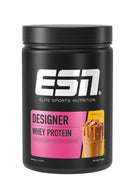
The proteins should come from different high-quality protein sources. Here, you should pay attention to a complete amino acid profile. A high-quality and cost-efficient way to meet your protein needs is ESN Designer Whey Protein.
Proteins are essential for muscle building and muscle maintenance.
Carbohydrates
The optimal amount depends on how much additional physical activity the athlete performs. The more cardiovascular training is performed, the higher the carbohydrate requirements.
Once you have determined your protein amount as well as your calorie amount, you can fill the remaining calories with carbohydrates. A good guideline is 4 to 7 g/kg.[5]
You can find some good carbohydrate sources in the already mentioned article.
Fat intake
Fats are of crucial importance for the female hormonal balance, as fats are essential for hormonal functions, especially testosterone production, as well as for the absorption of fat-soluble vitamins (A, D, E, K). The optimal amount of fat varies depending on individual goals, but an intake of about 20-30% of total calories from healthy fats is recommended. This roughly corresponds to 0.8-1 g of fat per kilogram of body weight. The focus should be on unsaturated fatty acids from sources such as nuts, avocados, olive oil and fatty fish, while saturated fats and trans fats should be consumed in moderation. Sufficient fat intake not only supports health, but can also promote muscle building and recovery processes. Women should generally have a slightly higher fat content in their diet to optimally support hormonal function.

Basically, women have a glycogen- and protein-sparing metabolism. This means that women do not need as many carbohydrates or proteins in their diet as men to be able to call upon their training performance.[6]
Omega-3 fatty acids are especially important here. These can be taken in the diet through fatty fish or through omega-3 capsules.
Omega-3 capsules from ESN offer a qualitative way to meet your intake here.
Female Athlete Triad
In addition to the many health benefits, there are also some risks that women should consider if they start bodybuilding. These risks refer above all to women who exercise a lot and may want to go on stage for a competition. It is important to mention that a woman who starts with natural bodybuilding or strength training does not immediately take these risks. Nevertheless, a certain awareness of the risks should be created.
The phenomenon of the "Female Athlete Triad" is a health issue that particularly affects active women, including many in competitive bodybuilding. It consists of three main components: energy availability, menstrual disorders and bone health. Female bodybuilders who have a strong calorie deficit through intensive training and insufficient food intake are particularly at risk of developing these problems. Therefore, it is not recommended for women to maintain a very low body fat percentage over a long period. This can under certain circumstances lead to one of the mentioned problems. Therefore, women without competition ambitions should not aim for a body fat percentage at which for example, the menstrual cycle is impaired.[7]
The risks manifest as follows:
- Low energy availability: Due to insufficient calorie intake in relation to energy expenditure, the body can no longer sufficiently support all vital functions.
- Menstrual disorders: These include irregular or absent periods (amenorrhea). This occurs when the body does not receive enough energy to maintain normal hormone production, which can disrupt the menstrual cycle.
- Reduced bone density: In the long term, the combination of energy deficiency and menstrual disorders leads to a loss of bone density and increases the risk of stress fractures as well as osteoporosis.[8]
In bodybuilding, there is a strong pressure to achieve a low body fat percentage, which makes women particularly susceptible to the Female Athlete Triad. The combination of intensive training sessions and diets for fat reduction can lead to insufficient energy availability. This brings the risk that the body does not have enough energy to maintain normal physiological processes such as the menstrual cycle or protect bone health. Since an extreme reduction of body fat is often aimed for in bodybuilding, female bodybuilders are particularly at risk here. A well-designed nutrition and training program that covers the energy requirements and takes into account the health of bones and hormonal balance is crucial to staying healthy in the long term. This should, however, above all be relevant for competitive athletes. Ideally, you get a professional coach for a competition diet. If you also plan to go on stage, you should familiarize yourself in advance with the different Bodybuilding Classes.
Conclusion
Strength training is of crucial importance for women, as it goes far beyond muscle building and offers comprehensive health benefits. It not only supports fat loss and muscle building, but also promotes metabolic health, increases the basal metabolic rate and protects against age-related problems such as osteoporosis. In addition, it improves cardiovascular health and has a positive effect on mental health by strengthening self-confidence and relieving symptoms of anxiety and depression. Natural bodybuilding for women without competition ambitions is a very healthy sport. As long as a sport goes in an extreme direction, it can by definition no longer be healthy. High-level competitive sports always carry certain risks.
Contrary to widespread fears, women do not need to worry about building "too much" muscle mass through strength training. Their physiology differs significantly from that of men, which means that muscle building is slower and more moderate. Women benefit from adapted training plans that focus on higher repetition numbers and more volume, as their body is more resistant to fatigue due to the higher estrogen level.
Last but not least, nutrition also plays a central role in optimally supporting muscle building. A balanced intake of proteins, carbohydrates and healthy fats is essential to support the hormonal balance and maximize training performance. However, it is important to be aware that an extreme calorie deficit can lead to negative health consequences such as the "Female Athlete Triad","especially in the competitive field.
In conclusion, strength training and bodybuilding represent a wonderful opportunity for women to build a healthy and mentally strong body.

